
Best Free Car Dealer Fee Estimator Apps
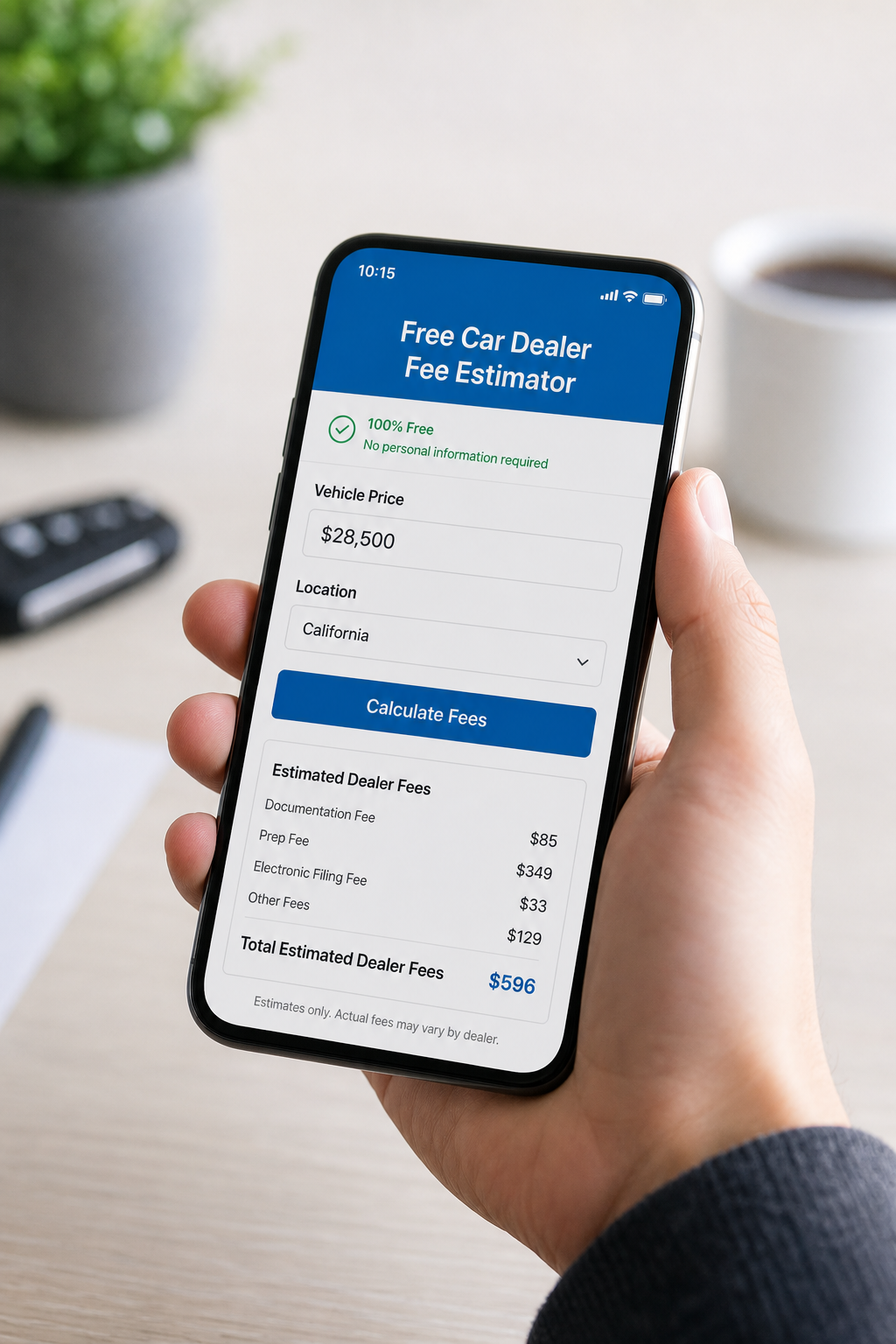
How to Avoid Hidden Dealer Fees When Buying a Car
Hook: If you’ve ever walked out of a dealership feeling like you just paid for a “premium” you never asked for, you’re not imagining it. The out‑the‑door price they quote you is a carefully layered trap of hidden dealer fees that most buyers never see coming. You’re about to learn exactly what those fees are, why they exist, and how to shut them down in seconds.
The Most Common Junk Fees Dealers Slip Into Your Buyer’s Order
Dealerships have turned fee‑stacking into an art form. Below is the play‑by‑play of every dealer add‑on you’ll encounter, whether it’s a legitimate cost or a pure cash‑grab. For each, we give you a one‑sentence script that forces the salesperson to justify or drop it.
Documentation Fee (Doc Fee)
What it is: A charge for “processing paperwork.” In most states it’s a flat administrative cost, but many dealers inflate it to $500‑$1,000.
Legitimacy: Only legal if it reflects actual labor and is disclosed before you sign. Anything above the state‑mandated cap is a junk fee.
Push‑back line: “My state caps the doc fee at $199; please remove the $799 charge and replace it with the statutory amount.”
Dealer Prep / Reconditioning Fee
What it is: Supposedly covers cleaning, minor repairs, and inspection before delivery.
Legitimacy: If the car truly needed work, the dealer must itemize each task with receipts. A blanket $300‑$600 fee with no detail is a scam.
Push‑back line: “Show me the invoice for each prep item; otherwise I’m dropping the $425 prep fee.”
Market Adjustment (or “Dealer Mark‑up”)
What it is: An arbitrary surcharge based on perceived demand for a model.
Legitimacy: Illegal in many states when not tied to a documented cost. It’s pure profit padding.
Push‑back line: “I’m buying at MSRP; any market adjustment must be removed unless you can prove a documented cost increase.”
VIN Etching
What it is: Etching the vehicle identification number onto windows as an anti‑theft measure.
Legitimacy: Optional service; you can have it done for $20‑$30 at a local shop. A $200‑$300 dealer charge is a markup.
Push‑back line: “I’ll handle VIN etching myself for $25; please delete the $275 dealer charge.”
Paint Protection Film / Ceramic Coating
What it is: A “protective” layer applied to the paint.
Legitimacy: Optional and often overpriced. If you want it, negotiate a separate price; never accept it bundled.
Push‑back line: “I’m not paying $1,200 for a coating I can buy for $300 elsewhere; remove it from the buyer’s order.”
Fabric / Interior Protection
What it is: A spray or sealant claimed to guard seats and carpet.
Legitimacy: Optional and rarely needed on a new car. Dealers inflate it to $300‑$500.
Push‑back line: “I decline fabric protection; delete the $425 line item.”
Nitrogen‑Filled Tires
What it is: Tires filled with nitrogen instead of air, marketed as a performance upgrade.
Legitimacy: No proven benefit for everyday drivers; a $150‑$250 charge is a junk fee.
Push‑back line: “I’ll keep standard air; please remove the nitrogen tire surcharge.”
Window Tint
What it is: Pre‑installed tint on windows.
Legitimacy: Legal only if it meets state tint laws and you’ve paid the correct tax. A $400‑$600 dealer add‑on is usually a markup.
Push‑back line: “I’m ordering a tint‑free vehicle; eliminate the $525 tint fee.”
Destination Charge Manipulation
What it is: The cost to ship the car from the factory to the dealer.
Legitimacy: Fixed by the manufacturer (usually $800‑$1,200). Dealers sometimes add “handling” on top of it.
Push‑back line: “The destination charge is $1,095 per the invoice; any extra handling fee must be removed.”
Dealer Add‑On Packages (e.g., “Premium Protection Package”)
What it is: Bundled bundles of the above items plus vague “service contracts.”
Legitimacy: All components are optional; packaging them forces you to pay for things you never asked for.
Push‑back line: “I decline the premium package; break it down and delete every line I didn’t request.”
How to Read a Buyer’s Order Line by Line
The buyer’s order is the dealer’s final sales contract. It’s a spreadsheet of every charge, and you can use it as a weapon. Follow this checklist:
- Vehicle Price: Verify the negotiated price matches what you agreed to verbally.
- Manufacturer’s Destination Charge: Should be a single, unaltered line with the exact amount from the invoice.
- Tax, Title, Registration: These are state‑mandated and vary by location. Cross‑check with your state’s tax rate.
- Doc Fee: Look for the exact dollar amount and compare it to your state’s cap.
- All “Dealer Add‑Ons”: Any line that isn’t a tax, title, registration, or destination is suspect. Highlight each and ask for a receipt.
- Total “Out the Door” (OTD) Price: This is the number you’ll actually pay. If any line feels inflated, demand it be removed before you sign.
When you spot a line you don’t recognize, pause the negotiation and say, “I need a detailed explanation for this charge before I can sign.” The dealer’s silence is often the first sign they’re bluffing.
State‑by‑State Fee Caps and What’s Actually Illegal
Every state sets its own limits on doc fees, registration, and certain add‑ons. Knowing the caps turns you from a clueless buyer into a legal enforcer. Below is a quick reference for the most aggressive states; you can expand it with a quick Google search for your specific jurisdiction.
- California: Doc fee capped at $199. Any amount above is illegal.
- Florida: No statutory doc fee cap, but “dealer prep” must be itemized and reasonable.
- Texas: Doc fee limited to $150; “market adjustment” must be disclosed in writing.
- New York: Destination charge is fixed; any “handling” surcharge over $100 is suspect.
- Illinois: VIN etching must be optional and priced under $30 if offered.
- Georgia: Paint protection film cannot exceed $250 unless you sign a separate contract.
- Washington: Nitrogen tire fill is prohibited as a dealer‑added cost.
If a dealer adds a fee that exceeds your state’s cap, you have the legal right to refuse to pay it and can even file a complaint with the state Attorney General. In many states, undisclosed “market adjustments” are considered deceptive trade practices and can be reported to the Better Business Bureau.
Car Buying Tips That Actually Work (No Fluff)
Now that you know the fees, here are three power moves that turn knowledge into savings:
- Pre‑Print Your Own Buyer’s Order: Use a spreadsheet to list the exact price, tax, title, registration, and the statutory doc fee. Hand it to the salesperson and say, “I’ll sign only if your order matches this.”
- Quote Competing Dealers Simultaneously: Call three dealers, get their written OTD numbers, and demand the lowest one match the others. Dealers hate being out‑priced in real time.
- Leverage the “Beat The Dealer” App: The app scans the buyer’s order on your phone, flags any junk fee, and whispers the exact script you need to say. It also shows the true market value of the car in seconds.
Call to Action: Arm Yourself with Beat The Dealer
Enough talk—take action. Download Beat The Dealer now. The free mobile app instantly scans any buyer’s order, highlights every hidden dealer fee, and gives you real‑time coaching on what to say. It also pulls the latest market data so you know the true value of any car before you step onto the lot.
Stop letting dealerships dictate the price. Use the knowledge in this article, demand transparency, and let Beat The Dealer be your courtroom for the car‑buying battlefield. Your wallet will thank you.